About
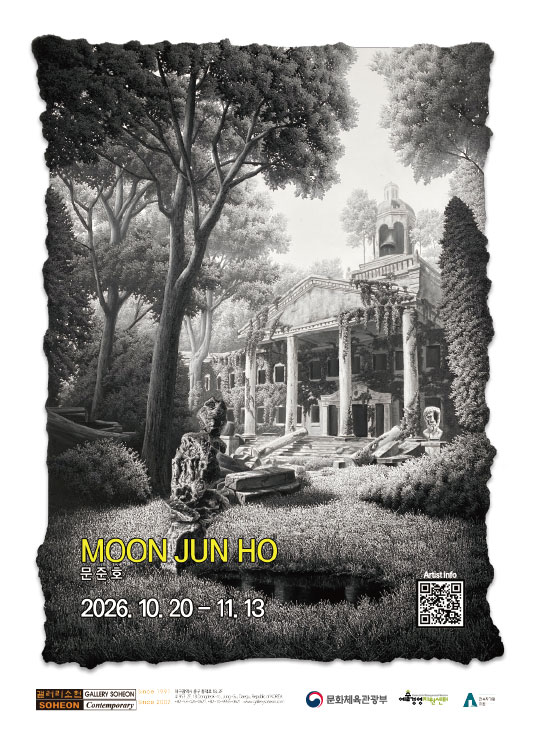
《Moon Jun-ho - Landscapes for What Remains》 2026.10.20 (Tue)–11.13 (Fri) (Closed Sundays and public holidays) 10:00–18:00 (weekdays) 11:00–17:00 (Saturdays) Advance reservation recommended (one day prior) Gallery Soheon & Soheon Contemporary 18 Dongdeok-ro, Jung-gu, Daegu (Daebong-dong) 2F Contact: art422@hanmail.net / 053-426-0621 / Instagram @gallerysoheon 010-9955-0621 (gallery phone) Gallery official website: www.gallerysoheon.com Official blog: blog.naver.com/soheoncontem Romantic Ruins, Landscapes for What Remains — The sublimity of infinite nature and 'finite' human civilization — Strange and mysterious landscapes created by intense light This is a solo exhibition by artist Moon Jun-ho, who expresses the story of infinite and wondrous nature and the finite human beings within it using the materiality of silicone, a symbolic material of contemporary society. The realistically depicted yet artist-reconstructed utopian natural landscapes offer multiple points of appreciation: the strong contrast of black and white, a distinctive thick matière, and the softness and rough heaviness the material provides. Viewers may reflect in the artificial utopia the artist has created, marvel at the unique matière and realistic expression, and contemplate the meaning of a new kind of landscape painting for our era. Landscapes for What Remains, by Lee Seon-yeong (art critic) Moon Jun-ho uses silicone sealant as if it were oil paint or acrylic. Of course, the basic use of its adhesive function—connecting separated things—is fundamental. Beyond works painted on canvas, he also uses silicone to join various materials such as wood, wire, and wire mesh to create sculpture and installation works. His thinking about adhesion combines with structured materials like wooden pegs and battens, transforming them into pedestals or additional picture planes. Works drawn by shooting silicone look no different from ordinary paintings at first glance. But the rubber-textured lumps that protrude beyond the frame clearly show the foreign character of the material. He has been using silicone since 2016, experimenting across a range from painting to sculpture throughout that time. Pushing the material to its maximum experimental possibilities has revealed the specificity of the medium. He says he has 'used silicone as both a painting material and a formative language in the process of painting natural landscapes.' The method of connecting what is separated also connects to the content of the work. Moon Jun-ho's landscapes are bleak, whether based on reality or fantasy. This is largely due to the gloomy atmosphere exuded by the dull color of the main material. While acrylic silicone sealant can come in colors, work since 2019 has been made primarily with black silicone. The dark, achromatic atmosphere is compounded by the hard properties inherent in the industrial material. …(continued) The main works in this exhibition are large-scale paintings, but he also regularly does a great deal of silicone drawing. These are also exhibited alongside the large works in this exhibition. Works depicting industrial landscapes of factories scratched into silicone with hard tools such as cotton swabs or screwdrivers, or works reflecting experiences in the military, connect material and content. Such drawings go well with cold metal frames. For him, drawing is the first step in his practice; he cuts canvas to 20×20 cm so it can be transferred directly to a frame, and some of these are later transferred to large canvases as paintings. Images related to factory workers at work or frontline soldiers are imbued with the artist's own experience, but they are also permeated by a life—defined by collectivism, compulsion, potential war, and competition—that any free artist would want to avoid. Recent works carry a surrealist mystique, but the sense of ruination remains. Just as modern kitsch is the flip side of fine art, Romanticism is the flip side of harsh reality. For Moon Jun-ho, silicone is what connects a bleak reality with the romantic fantasy derived from it. Consider the fantastical culture and art that flourished dramatically in industrializing Britain, where coal-powered factories ran ceaselessly and the entire landscape turned pitch black. John Harvey, in [The Culture of Black Fashion], notes that the words 'dark' and 'black' appearing in Dickens and other British writers continue to appear in descriptions of docks, railways, factories, offices, churches, and prisons—'dark and desolate streets,' 'full of black soil and rotten water.' He says London's smoky haze is evocative of black. Conversely, black can also be connected to the romantic: 'There the leisurely melancholy of the romantic hero is combined… the sepulchral manner, the mysterious past, the desolation, the display of death…' (John Harvey). The landscapes he has painted in earnest since 2019 are romantic natural scenes including forests, light, waterfalls, and rivers, and are not painted from actual landscapes. They are scenes created by editing and compositing plausible images from various sources, including games. About the inclusion in the paintings of not only sculptural works made from silicone waste but also images of man-made structures crumbled by time, the artist speaks of 'landscapes for the discarded.' The scene of a ruin bathed in full sunlight—what time has destroyed, and the remnants that nonetheless remain—invites contemplation. … (continued) Artist Moon Jun-ho graduated from the College of Fine Arts at Keimyung University, known for its strength in realistic figurative painting. In 2024, he won the grand prize at the H-EAA Hoban Young Artist Art Competition and drew attention at the group exhibition of award-winning artists at Art Space Hohwa for the remarkable scale and sensory expression of materials. He received the Excellence Award as a selected artist for the 2026 AG New Artist Award hosted by the Ankuk Culture Foundation. He is currently working across painting, three-dimensional sculpture, and installation, and continues to broaden his artistic scope across genres, including capturing moments of everyday figures in drawings and incorporating them into silicone paintings.
Moon Jun-ho Exhibition - Landscapes for What Remains (문준호 전 - 남겨진 것들을 위한 풍경)
Tue, Oct 20 – Fri, Nov 13
25 days
Gallery Soheon & Soheon Contemporary
대구광역시 중구 동덕로 18 갤러리소헌
Free
Contact +82 53-426-0621,-+82 10-9955-0621
About
《Moon Jun-ho - Landscapes for What Remains》 2026.10.20 (Tue)–11.13 (Fri) (Closed Sundays and public holidays) 10:00–18:00 (weekdays) 11:00–17:00 (Saturdays) Advance reservation recommended (one day prior) Gallery Soheon & Soheon Contemporary 18 Dongdeok-ro, Jung-gu, Daegu (Daebong-dong) 2F Contact: art422@hanmail.net / 053-426-0621 / Instagram @gallerysoheon 010-9955-0621 (gallery phone) Gallery official website: www.gallerysoheon.com Official blog: blog.naver.com/soheoncontem Romantic Ruins, Landscapes for What Remains — The sublimity of infinite nature and 'finite' human civilization — Strange and mysterious landscapes created by intense light This is a solo exhibition by artist Moon Jun-ho, who expresses the story of infinite and wondrous nature and the finite human beings within it using the materiality of silicone, a symbolic material of contemporary society. The realistically depicted yet artist-reconstructed utopian natural landscapes offer multiple points of appreciation: the strong contrast of black and white, a distinctive thick matière, and the softness and rough heaviness the material provides. Viewers may reflect in the artificial utopia the artist has created, marvel at the unique matière and realistic expression, and contemplate the meaning of a new kind of landscape painting for our era. Landscapes for What Remains, by Lee Seon-yeong (art critic) Moon Jun-ho uses silicone sealant as if it were oil paint or acrylic. Of course, the basic use of its adhesive function—connecting separated things—is fundamental. Beyond works painted on canvas, he also uses silicone to join various materials such as wood, wire, and wire mesh to create sculpture and installation works. His thinking about adhesion combines with structured materials like wooden pegs and battens, transforming them into pedestals or additional picture planes. Works drawn by shooting silicone look no different from ordinary paintings at first glance. But the rubber-textured lumps that protrude beyond the frame clearly show the foreign character of the material. He has been using silicone since 2016, experimenting across a range from painting to sculpture throughout that time. Pushing the material to its maximum experimental possibilities has revealed the specificity of the medium. He says he has 'used silicone as both a painting material and a formative language in the process of painting natural landscapes.' The method of connecting what is separated also connects to the content of the work. Moon Jun-ho's landscapes are bleak, whether based on reality or fantasy. This is largely due to the gloomy atmosphere exuded by the dull color of the main material. While acrylic silicone sealant can come in colors, work since 2019 has been made primarily with black silicone. The dark, achromatic atmosphere is compounded by the hard properties inherent in the industrial material. …(continued) The main works in this exhibition are large-scale paintings, but he also regularly does a great deal of silicone drawing. These are also exhibited alongside the large works in this exhibition. Works depicting industrial landscapes of factories scratched into silicone with hard tools such as cotton swabs or screwdrivers, or works reflecting experiences in the military, connect material and content. Such drawings go well with cold metal frames. For him, drawing is the first step in his practice; he cuts canvas to 20×20 cm so it can be transferred directly to a frame, and some of these are later transferred to large canvases as paintings. Images related to factory workers at work or frontline soldiers are imbued with the artist's own experience, but they are also permeated by a life—defined by collectivism, compulsion, potential war, and competition—that any free artist would want to avoid. Recent works carry a surrealist mystique, but the sense of ruination remains. Just as modern kitsch is the flip side of fine art, Romanticism is the flip side of harsh reality. For Moon Jun-ho, silicone is what connects a bleak reality with the romantic fantasy derived from it. Consider the fantastical culture and art that flourished dramatically in industrializing Britain, where coal-powered factories ran ceaselessly and the entire landscape turned pitch black. John Harvey, in [The Culture of Black Fashion], notes that the words 'dark' and 'black' appearing in Dickens and other British writers continue to appear in descriptions of docks, railways, factories, offices, churches, and prisons—'dark and desolate streets,' 'full of black soil and rotten water.' He says London's smoky haze is evocative of black. Conversely, black can also be connected to the romantic: 'There the leisurely melancholy of the romantic hero is combined… the sepulchral manner, the mysterious past, the desolation, the display of death…' (John Harvey). The landscapes he has painted in earnest since 2019 are romantic natural scenes including forests, light, waterfalls, and rivers, and are not painted from actual landscapes. They are scenes created by editing and compositing plausible images from various sources, including games. About the inclusion in the paintings of not only sculptural works made from silicone waste but also images of man-made structures crumbled by time, the artist speaks of 'landscapes for the discarded.' The scene of a ruin bathed in full sunlight—what time has destroyed, and the remnants that nonetheless remain—invites contemplation. … (continued) Artist Moon Jun-ho graduated from the College of Fine Arts at Keimyung University, known for its strength in realistic figurative painting. In 2024, he won the grand prize at the H-EAA Hoban Young Artist Art Competition and drew attention at the group exhibition of award-winning artists at Art Space Hohwa for the remarkable scale and sensory expression of materials. He received the Excellence Award as a selected artist for the 2026 AG New Artist Award hosted by the Ankuk Culture Foundation. He is currently working across painting, three-dimensional sculpture, and installation, and continues to broaden his artistic scope across genres, including capturing moments of everyday figures in drawings and incorporating them into silicone paintings.
More shows & exhibitions
Moon Jun-ho 《Landscapes for What Remains》 (문준호 《남겨진 것들을 위한 풍경》)
Tue, Oct 20 – Fri, Nov 13Free entry
Park So-jin Solo Exhibition “Turn Right Shortly” (취미인간에서 들리는 전시 프로젝트 Vol. 2 박소진 개인전 <잠시 후 우회전입니다>)
Sat, Oct 24 – Wed, Nov 18Free entry
Suseong International Biennale (수성국제비엔날레)
Tue, Oct 27 – Sun, Nov 22Free entry
2026 Daegu Art Factory Creative Residency 16th Cohort Showcase <The Gravity of Gravity> (2026 대구예술발전소 창작 레지던시 제16기 성과전 <중력의 중력>)
Tue, Oct 27 – Sun, Nov 15Free entry
AS THINGS FADE – While Things Fade Exhibition (AS THINGS FADE - 사라지는 사이에 展)
Mon, Nov 9 – Fri, Nov 20Free entry
Kaein Exhibition (開人展)
Tue, Nov 10 – Sat, Nov 28Free entry
Daegu City Arts Company, Ryuhwa (대구시립예술단, 류화)
Thu, Nov 12 – Fri, Nov 13
[Daegu] Come and See Me ([대구] 날 보러 와요)
Thu, Nov 12 – Sun, Nov 15
Glass Box Series Exhibition: Woo Deok-ha REVERSE FLOW (유리상자 시리즈展 우덕하 REVERSE FLOW)
Tue, Oct 27 – Sun, Dec 20Free entry
Palimpsest (Palimpsest : 겹쳐 쓰기)
Fri, Sep 11 – Wed, Dec 2Free entry
Source: Korea Culture Information Service Agency (Korean listing, translated by us)
Data as of 11.12. Dates and prices can change, so check the official site before you go.