About
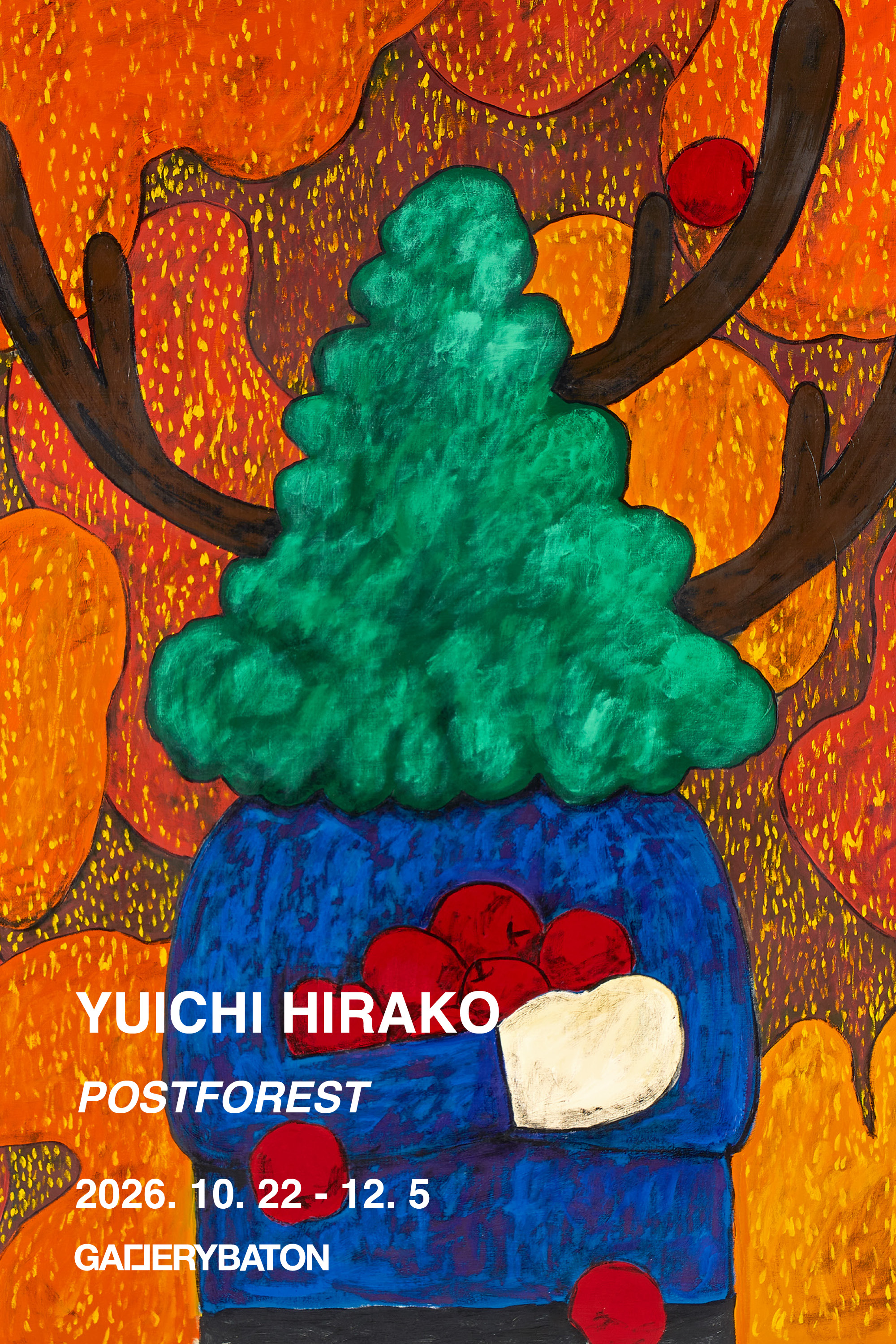
Gallery Baton presents POSTFOREST, a solo exhibition by Yuichi Hirako (b. 1982), from October 22 to December 5, 2026, at its exhibition space in Hannam-dong. Working across painting, sculpture, and installation, Hirako has built a distinctive visual language centered on hybrid figures drawn from nature. This is the artist's third solo exhibition at Baton. Internationally recognized for an ecological imagination and messages of coexistence, Hirako uses new paintings and sculptures to reinterpret the forest as both a natural realm and a layered place where narrative, community, and anonymity intersect. Hirako grew up surrounded by nature in Okayama Prefecture, Japan. While studying in London, the artist noticed that urban green spaces, street trees, and indoor plants mostly exist for human rest and emotional comfort, and cannot grow according to their own natural principles. This modern tendency to objectify nature, rather than letting it exist in its own right, became a question running through Hirako's later work. Seeing nature as an independent being equal to humans also connects with the thinking of Deep Ecology. Rather than directly denouncing damaged nature, Hirako has expressed this belief gently and consistently through the visual language of painting and sculpture. Hirako's central narrative follows human-like figures living leisurely alongside other creatures in a forest on the far side of the Earth. Dogs, cats, other animals, and plants appear like supporting characters in a feature-length animation, conveying the situation in each scene, adding rhythm, and branching the narrative into smaller stories. In the large-scale installation Tree, Forest, Mountain, first shown in the 2025 solo exhibition ORIGIN at the Okayama Prefectural Museum of Art and presented again at Art Basel Unlimited in 2026, the artist filled a circular platform with hybrid sculptures to form a clustered landscape. Arranged in a circle, the sculptures gaze at viewers in the center, not as nature in an anonymous background but as beings equal to humans. By having humans and nature, long arranged for human use, face each other at eye level, the work returns them to a horizontal relationship. In this exhibition, the artist extends that relationship vertically, presenting suspended sculptures for the first time. Occupying one section of the gallery from top to bottom, the work scatters sculptures of different sizes and shapes through the air, unlike earlier works clustered on the floor. Instead of facing the works from a fixed viewpoint, visitors walk among the floating forms. In this experience, similar to passing through a forest, the gallery becomes a place that responds to the visitor's body. The title POSTFOREST reflects the artist's historical view: just as human ways of seeing and defining nature have fundamentally changed over the past century, the relationship between nature and humans will keep being reshaped in the future. Hirako accepts this change as a natural transition rather than rupture or loss, and has developed the work with relationships yet to form in mind. The exhibition reflects on the present relationship between nature and humans and invites visitors to consider the direction of coexistence to come.
Yuichi Hirako: POSTFOREST (유이치 히라코: POSTFOREST)
Thu, Oct 22 – Sat, Dec 5
Gallery Baton
서울특별시 용산구 독서당로 116 태석빌딩
3K Oksu
about 750 m away
Free
Contact +82 2-597-5701
About
Gallery Baton presents POSTFOREST, a solo exhibition by Yuichi Hirako (b. 1982), from October 22 to December 5, 2026, at its exhibition space in Hannam-dong. Working across painting, sculpture, and installation, Hirako has built a distinctive visual language centered on hybrid figures drawn from nature. This is the artist's third solo exhibition at Baton. Internationally recognized for an ecological imagination and messages of coexistence, Hirako uses new paintings and sculptures to reinterpret the forest as both a natural realm and a layered place where narrative, community, and anonymity intersect. Hirako grew up surrounded by nature in Okayama Prefecture, Japan. While studying in London, the artist noticed that urban green spaces, street trees, and indoor plants mostly exist for human rest and emotional comfort, and cannot grow according to their own natural principles. This modern tendency to objectify nature, rather than letting it exist in its own right, became a question running through Hirako's later work. Seeing nature as an independent being equal to humans also connects with the thinking of Deep Ecology. Rather than directly denouncing damaged nature, Hirako has expressed this belief gently and consistently through the visual language of painting and sculpture. Hirako's central narrative follows human-like figures living leisurely alongside other creatures in a forest on the far side of the Earth. Dogs, cats, other animals, and plants appear like supporting characters in a feature-length animation, conveying the situation in each scene, adding rhythm, and branching the narrative into smaller stories. In the large-scale installation Tree, Forest, Mountain, first shown in the 2025 solo exhibition ORIGIN at the Okayama Prefectural Museum of Art and presented again at Art Basel Unlimited in 2026, the artist filled a circular platform with hybrid sculptures to form a clustered landscape. Arranged in a circle, the sculptures gaze at viewers in the center, not as nature in an anonymous background but as beings equal to humans. By having humans and nature, long arranged for human use, face each other at eye level, the work returns them to a horizontal relationship. In this exhibition, the artist extends that relationship vertically, presenting suspended sculptures for the first time. Occupying one section of the gallery from top to bottom, the work scatters sculptures of different sizes and shapes through the air, unlike earlier works clustered on the floor. Instead of facing the works from a fixed viewpoint, visitors walk among the floating forms. In this experience, similar to passing through a forest, the gallery becomes a place that responds to the visitor's body. The title POSTFOREST reflects the artist's historical view: just as human ways of seeing and defining nature have fundamentally changed over the past century, the relationship between nature and humans will keep being reshaped in the future. Hirako accepts this change as a natural transition rather than rupture or loss, and has developed the work with relationships yet to form in mind. The exhibition reflects on the present relationship between nature and humans and invites visitors to consider the direction of coexistence to come.
More shows & exhibitions
Ban Min-su: Who Will Go Before Us (반민수: 𝐖𝐡𝐨 𝐖𝐢𝐥𝐥 𝐆𝐨 𝐁𝐞𝐟𝐨𝐫𝐞 𝐔𝐬)
Thu, Oct 22 – Sat, Nov 14Free entry
2026 Namsan Night Festival (2026 남산 나이트 페스티벌)
Fri, Oct 23 – Sat, Nov 14Free entry
[Seoul Gwangjin] Nambeol ([서울 광진] 남벌)
Fri, Oct 23 – Sat, Nov 14
In the Midst of Countless Beginnings (무수한 시작의 가운데에서)
Sat, Oct 24 – Tue, Nov 17Free entry
[Seoul Seodaemun] If You Want a Red Apple ([서울 서대문] 빨간 사과가 먹고 싶다면)
Sat, Oct 24 – Sun, Nov 15
[Daehangno] Majesty ([대학로] 마제스티)
Sun, Oct 25 – Sun, Nov 15
[Gallery 9.5] FONS: Collected Moments ([갤러리 9.5] FONS 수집된 순간)
Sun, Oct 25 – Sat, Nov 14Free entry
Kate Solo Exhibition: A World Still Soft (카테 개인전 "아직 무른 세계")
Tue, Oct 27 – Wed, Nov 25Free entry
Chunja in Wonderland, Yongsan musical ([서울 용산] 이상한 나라의 춘자씨)
Fri, Oct 16 – Sun, Nov 15
Park Ji-hye Solo Exhibition: Since The Day (박지혜 개인전 《그 날 이후 Since The Day》)
Fri, Oct 30 – Thu, Nov 12Free entry
Places to visit nearby


Source: Korea Culture Information Service Agency (Korean listing, translated by us)
Data as of 11.12. Dates and prices can change, so check the official site before you go.