About
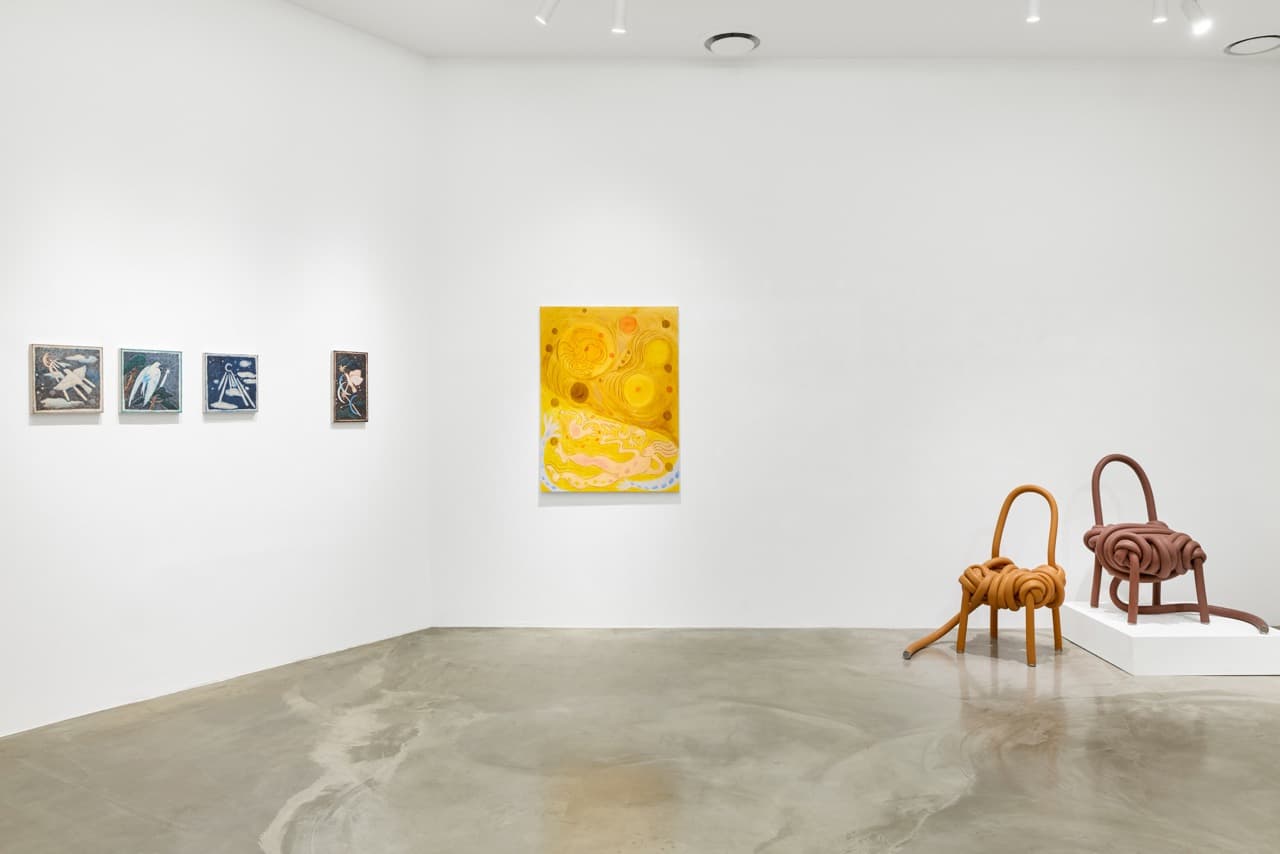
Atelier Aki presents 《Between Forms》, its final curated exhibition of 2026, from November 5 to December 19. The exhibition brings together three millennial-generation artists, Greem Jeong, Jin Jihyun, and Yuseong Choe, and looks at how each builds form, and the thinking behind it, through different mediums and visual languages: sculpture, traditional Korean painting, and oil painting. In doing so, it highlights the diversity and flexibility of contemporary art that cannot be defined by a single form. Greem Jeong extends the movement of lines into spatial structures, testing the relationship between function and sculptural form. She builds her own visual language where the use of objects such as chairs and lighting meets the sculptural structures that lines create. Jin Jihyun layers ink and color on hanji (traditional Korean paper) to make visible scenes where reality and inner landscapes coexist. Birds and moons in her works are familiar everyday subjects as well as images that call up memory and emotion. Yuseong Choe responds to the movement of her body and the material qualities of oil paint, balancing figures and fields of color. Shapes that suggest real things form organic relationships with freely flowing lines and color fields. Though they start from different mediums, the three artists share the view that form is not limited to a fixed appearance or a single meaning. Form is shaped by the properties of materials and the artist’s choices, and gains new meaning from the space where a work is shown and from each viewer’s memories and gaze. The “between” in the title refers to the many relationships that arise as forms are made and interpreted. Through three different approaches, the exhibition explores the possibilities of form and seeks to broaden how we see it, from the making of a work to how it is viewed and interpreted. Greem Jeong works across sculpture, furniture, and installation, drawing on the movement of lines and the qualities of materials. Her signature 〈Mono Series〉 forms a sculptural structure in space from a single continuous line. Following the intuition of her hands, she bends and extends the line to find rhythm and balance. Materials once used as industrial parts go beyond their original function to become sculptural elements of form. The lines support the structure while dividing and flowing through space, revealing organic movement. In 〈Knot Chair〉, lines tangled like knots merge with the structure of a chair. Viewers recognize its use as a chair while also noticing the flow and overlap of lines and the empty spaces between them. Contours that shift with the viewer’s position let a functional object be seen as a sculpture. In her work, form appears in many ways through its relationship with the viewer’s viewpoint and movement and with the surrounding space. Jin Jihyun paints living things she encounters in daily life, and the memories tied to them, in ink and color on hanji. Birds, moons, and flowers come from real landscapes, yet take on an unfamiliar mood as memory and emotion overlap. According to her artist statement, night is when memories, emotions, anxieties, and hopes that were faint during the day come to the surface. She calls these inner traces “ghosts” and places them in one landscape with visible beings. In 〈The Moon and a Flock of Birds〉 (2025) and 〈Lily of the Valley and the Night Bird〉 (2026), complex emotions that cannot be reduced to one meaning emerge beyond familiar forms. The shades of ink and the colors soaked into the hanji reveal their subjects without fixing their meaning. Rather than carrying set symbols, the birds and moon lead viewers into scenes where reality and imagination meet. In her work, form makes invisible emotions perceptible and leaves room for viewers to layer in their own memories. Yuseong Choe’s work begins with formal ideas about shape, arrangement, and composition, but she does not decide the final image in advance. The movement of her wrist and shoulder, the state of the paint, and the colors and forms already on the canvas shape her next decision. She watches the changes that occur as she paints and, when needed, steps back into relationships already made. Chance results go through revision and selection and become a way to develop the painting. In her new works, shown for the first time in this exhibition, forms that suggest figures and living creatures blend with winding lines and organic color fields. When one form changes, the surrounding colors and space look different, leading to yet another choice. The viewer’s gaze also moves between individual forms and the movement of the whole picture. By continually adjusting these relationships, Choe finds her own standards of balance and completion within the work. The flexibility of her paintings comes from responding to possibilities discovered while painting and letting the canvas keep changing. Where does form begin, and how does it take shape? Rather than giving one answer, the three artists show the many ways form is made and transformed. The hand’s sense of balance in a line, memory and emotion seeping into ink, and decisions that respond to changes on the canvas each show how form takes shape under different conditions and choices. Moving between lines in sculpture and in painting, and between ink tones on hanji and color fields on canvas, viewers discover that the meaning of form shifts with their gaze and experience, even in a finished work. 《Between Forms》 focuses on the space between the choices made in creating and the interpretations that open up in viewing, and proposes seeing the completion of a form not as an end point but as the place where new relationships begin.
Between Forms (형태의 사이 Between Forms)
Thu, Nov 5 – Sat, Dec 19
Atelier Aki
서울 성동구 서울숲2길 32-14 갤러리아 포레
B Seoul-forest
about 300 m away
Free
Contact +82 2-464-7710
About
Atelier Aki presents 《Between Forms》, its final curated exhibition of 2026, from November 5 to December 19. The exhibition brings together three millennial-generation artists, Greem Jeong, Jin Jihyun, and Yuseong Choe, and looks at how each builds form, and the thinking behind it, through different mediums and visual languages: sculpture, traditional Korean painting, and oil painting. In doing so, it highlights the diversity and flexibility of contemporary art that cannot be defined by a single form. Greem Jeong extends the movement of lines into spatial structures, testing the relationship between function and sculptural form. She builds her own visual language where the use of objects such as chairs and lighting meets the sculptural structures that lines create. Jin Jihyun layers ink and color on hanji (traditional Korean paper) to make visible scenes where reality and inner landscapes coexist. Birds and moons in her works are familiar everyday subjects as well as images that call up memory and emotion. Yuseong Choe responds to the movement of her body and the material qualities of oil paint, balancing figures and fields of color. Shapes that suggest real things form organic relationships with freely flowing lines and color fields. Though they start from different mediums, the three artists share the view that form is not limited to a fixed appearance or a single meaning. Form is shaped by the properties of materials and the artist’s choices, and gains new meaning from the space where a work is shown and from each viewer’s memories and gaze. The “between” in the title refers to the many relationships that arise as forms are made and interpreted. Through three different approaches, the exhibition explores the possibilities of form and seeks to broaden how we see it, from the making of a work to how it is viewed and interpreted. Greem Jeong works across sculpture, furniture, and installation, drawing on the movement of lines and the qualities of materials. Her signature 〈Mono Series〉 forms a sculptural structure in space from a single continuous line. Following the intuition of her hands, she bends and extends the line to find rhythm and balance. Materials once used as industrial parts go beyond their original function to become sculptural elements of form. The lines support the structure while dividing and flowing through space, revealing organic movement. In 〈Knot Chair〉, lines tangled like knots merge with the structure of a chair. Viewers recognize its use as a chair while also noticing the flow and overlap of lines and the empty spaces between them. Contours that shift with the viewer’s position let a functional object be seen as a sculpture. In her work, form appears in many ways through its relationship with the viewer’s viewpoint and movement and with the surrounding space. Jin Jihyun paints living things she encounters in daily life, and the memories tied to them, in ink and color on hanji. Birds, moons, and flowers come from real landscapes, yet take on an unfamiliar mood as memory and emotion overlap. According to her artist statement, night is when memories, emotions, anxieties, and hopes that were faint during the day come to the surface. She calls these inner traces “ghosts” and places them in one landscape with visible beings. In 〈The Moon and a Flock of Birds〉 (2025) and 〈Lily of the Valley and the Night Bird〉 (2026), complex emotions that cannot be reduced to one meaning emerge beyond familiar forms. The shades of ink and the colors soaked into the hanji reveal their subjects without fixing their meaning. Rather than carrying set symbols, the birds and moon lead viewers into scenes where reality and imagination meet. In her work, form makes invisible emotions perceptible and leaves room for viewers to layer in their own memories. Yuseong Choe’s work begins with formal ideas about shape, arrangement, and composition, but she does not decide the final image in advance. The movement of her wrist and shoulder, the state of the paint, and the colors and forms already on the canvas shape her next decision. She watches the changes that occur as she paints and, when needed, steps back into relationships already made. Chance results go through revision and selection and become a way to develop the painting. In her new works, shown for the first time in this exhibition, forms that suggest figures and living creatures blend with winding lines and organic color fields. When one form changes, the surrounding colors and space look different, leading to yet another choice. The viewer’s gaze also moves between individual forms and the movement of the whole picture. By continually adjusting these relationships, Choe finds her own standards of balance and completion within the work. The flexibility of her paintings comes from responding to possibilities discovered while painting and letting the canvas keep changing. Where does form begin, and how does it take shape? Rather than giving one answer, the three artists show the many ways form is made and transformed. The hand’s sense of balance in a line, memory and emotion seeping into ink, and decisions that respond to changes on the canvas each show how form takes shape under different conditions and choices. Moving between lines in sculpture and in painting, and between ink tones on hanji and color fields on canvas, viewers discover that the meaning of form shifts with their gaze and experience, even in a finished work. 《Between Forms》 focuses on the space between the choices made in creating and the interpretations that open up in viewing, and proposes seeing the completion of a form not as an end point but as the place where new relationships begin.
More shows & exhibitions
2026 Seolleung Arts Hall 9th [I AM YOU] (2026 선릉아트홀 제9회 [I AM YOU])
Thu, Nov 5 – Sun, Nov 22
The Theoretical Practice of Architect Jeong Jin-guk (건축가 정진국의 이론적 실천)
Thu, Nov 5 – Sun, Nov 15Free entry
Guided Tours of the Seoul Botanic Park 2026 Special Exhibition "Tender Balance: Reflecting Each Other" (서울식물원 2026 기획전 《다정한 균형: 서로를 비추는》 전시해설 프로그램)
Thu, Nov 5 – Sat, Nov 28Free entry
Woo Byeong-chul Solo Exhibition (우병출 개인전)
Thu, Nov 5 – Sat, Nov 28Free entry
Sangdo Eoulmadang Art Hall 3rd Anniversary: “Sangdo Playground” (2026 상도어울마당 아트홀 개관 3주년 기획 프로그램 <상도 놀이터>)
Wed, Nov 4 – Wed, Nov 18
Han Jung-ok Solo Exhibition: A Million Knife Strokes (한중옥 개인전 《백만 번의 칼질》)
Wed, Nov 4 – Mon, Nov 23Free entry
[Look Inside Gallery] Jang Il-am Solo Exhibition 《The Recluse's Wish》 ([룩인사이드 갤러리] 장일암 개인전 《은둔자의 바람》)
Wed, Nov 4 – Mon, Nov 23Free entry
Paper, Pencil, Eraser, Book (종이, 연필, 지우개, 책 Paper, Pencil, Eraser, Book)
Wed, Nov 4 – Fri, Nov 27Free entry
[Seoul Yangcheon] 2026 Live Family Musical The Nutcracker ([서울 양천] 2026 라이브 가족뮤지컬 호두까기 인형)
Wed, Nov 4 – Sun, Nov 29
Times of Speculation (추측의 시간들)
Fri, Nov 6 – Fri, Nov 20Free entry
Places to visit nearby



Source: Korea Culture Information Service Agency (Korean listing, translated by us)
Data as of 11.12. Dates and prices can change, so check the official site before you go.