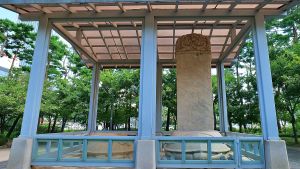

Samjeondo Stele서울 삼전도비
Name translated by Tripbloom
서울특별시 송파구 삼학사로 136 (잠실동)
Nearest subway station
28Jamsil
about 665 m away
About
This stele records the "merits" of Emperor Taizong of Qing. Joseon was defeated by the Qing during the Qing invasion of 1636 (Byeongja Horan) and forced into a humiliating peace treaty, and the emperor demanded that the monument be built. It was erected in 1639, the 17th year of King Injo's reign. The stele is 3.95 m tall and 1.4 m wide, and its title reads "Monument to the Merits of the Great Qing Emperor." Up to the early Joseon period, the Jurchens had paid tribute to Joseon. When the Ming dynasty fell into turmoil, they grew quickly in power and founded the Later Jin. As they kept expanding, they put pressure on Joseon, even invading it, and relations between the two grew strained. After the Jurchens renamed their state Qing, they demanded that Joseon treat them as a vassal would, and the two countries cut ties. In 1636, the 14th year of King Injo's reign, Emperor Taizong of Qing personally led an army of 100,000 into Joseon, starting the Byeongja Horan. King Injo held out at Namhansanseong Fortress, but in the end he surrendered at the Samjeondo ferry landing on the Han River, where the Qing army was camped, and agreed to a humiliating peace treaty. After the war, Emperor Taizong forced Joseon to put up a monument praising his merits, and the result was the Samjeondo Stele. The inscription was composed by Yi Gyeong-seok and written by O Jun, and the title was written by Yeo I-jing. The front of the stele is inscribed in Mongolian script on the left and Manchu script on the right, and the back is written in Chinese characters. This makes it an important source for the study of the Manchu and Mongolian languages. (Source: Songpa-gu Office website)
Description translated by Tripbloom from Korea Tourism Organization data
 K-MetroKorea Subway Map · route to JamsilOpen
Nearby places



Photo & data: Korea Tourism Organization · KOGL Type 3