
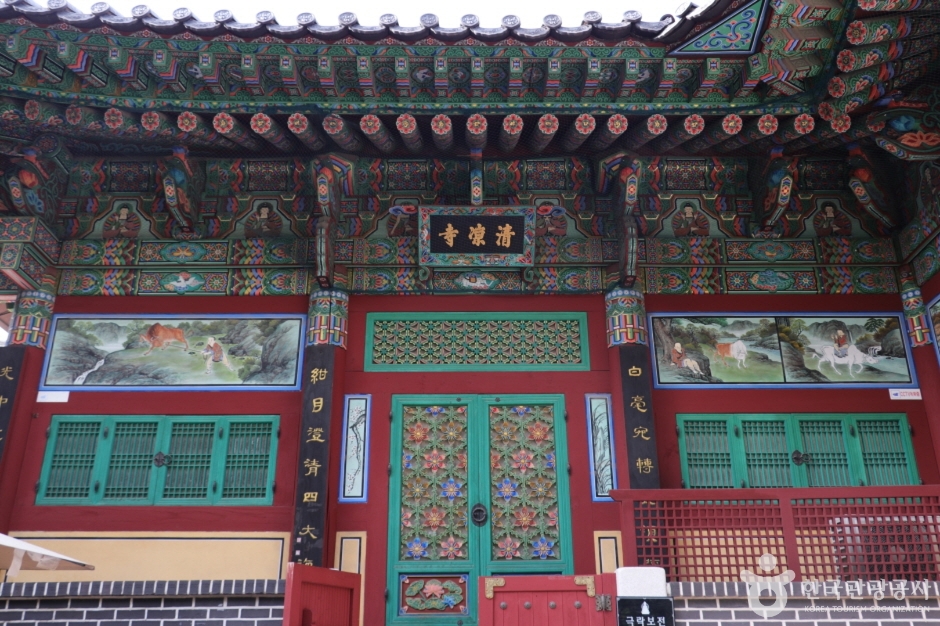
Cheongnyangsa Temple청량사(서울)
Name translated by Tripbloom
서울특별시 동대문구 제기로31길 10-3 청량사
Nearest subway station
1KCBCheongnyangni
about 801 m away
About
Cheongnyangsa Temple is a temple for Buddhist nuns on the southern slope of Cheonjangsan Mountain. This is the site of Dolkkoji Seungbang, long famous as one of the four great nunneries. Cheongnyangsa and Dolkkoji Seungbang were originally separate temples. In 1895, Empress Myeongseong was assassinated as part of Japan's scheme to seize Joseon, and when her tomb, Hongneung, was built, Cheongnyangsa, which had stood on that site, was moved to its present location. Around the same time, Dolkkoji Seungbang was in decline, so the two temples are said to have merged. In the late Joseon period it was a retreat where people from the capital often came to rest, and during the Japanese colonial period, when the nation was struggling, many patriots and eminent monks visited. In particular, Manhae Han Yong-un, a leader of the independence movement and Buddhist movement under Japanese rule, is said to have stayed at Cheongnyangsa for a time, and a modest celebration of his 60th birthday was held here on July 12, 1939. Around the same time, the Buddhist scholar Park Han-yeong also lived at the temple, and the Cheongnyangsa name plaque hanging in the Daebang hall is said to be in his handwriting. Behind Gwaneumjeon Hall, which appears right after you enter the temple gate, you can see high-rise apartments. Perhaps because it sits in a residential area, the temple runs a daycare center and has a playground for children. Geungnakbojeon Hall, the oldest building at Cheongnyangsa, has a jewel finial like a small pagoda set in the center of its roof. Probably because the temple is built on a slope, its buildings are packed closely together, almost like a multi-level structure. Though small, it has all the elements of a temple, including Gwaneumjeon, Muryangsujeon, Daeungjeon, Daebangchae, Seolseondang, and Jeongmukdang halls.
Description translated by Tripbloom from Korea Tourism Organization data
 K-MetroKorea Subway Map · route to CheongnyangniOpen
Events nearby
Nearby places



Photo & data: Korea Tourism Organization · KOGL Type 3